Ground-mounted / floor-standing
Independent storage on a prepared foundation. Check available land, drainage, anchoring, gas piping and access for membrane maintenance.
Review this configuration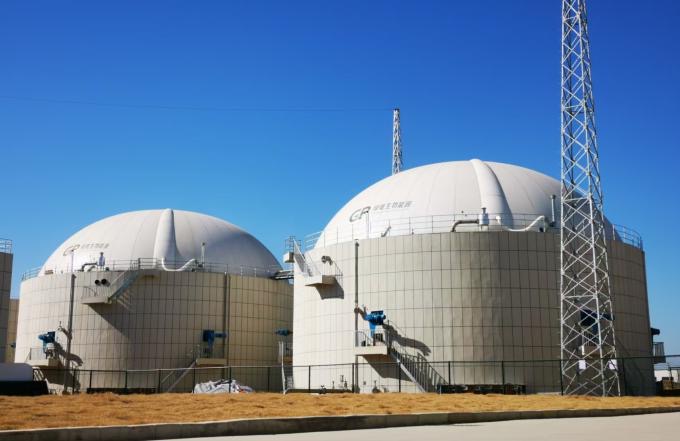
A tank-top double membrane gas holder for digesters, reactors, and integrated roof-mounted storage applications.
Request a project-specific quoteProduct Overview
A tank-top double membrane gas holder for digesters, reactors, and integrated roof-mounted storage applications.
Its value lies in tighter system integration, a smaller plot requirement, and shorter gas routes while retaining mature double-membrane pressure and safety logic.
Comparing gas-holder designs? Understand how wet, conventional dry-seal piston and double-membrane systems differ in sealing and maintenance: Gas-holder types and selection basics. Product specifications and quotations remain specific to this equipment and your project duty.
Include installation guidance, commissioning, training, spares and membrane-replacement needs in the inquiry. Service territory, site attendance, response arrangements and warranty terms follow the agreed contract.
Compare quotations on the same usable volume, pressure and gas duty. Membrane specification, site loads, support-air equipment, instruments, controls, transport, installation and after-sales scope affect the package price. A nominal-volume price alone is not a like-for-like comparison; request an itemized project quotation.
For an existing holder, provide drawings, operating conditions and inspection photographs before deciding on repair or replacement. Retaining an outer membrane requires its condition and compatibility to be assessed; the sealing interfaces, lifting plan, controls and acceptance tests must also be defined. The records below explain the work, not a guarantee that every existing holder is suitable.
Double membrane gasholder and double membrane gas holder describe the same low-pressure storage system. Start with the installation arrangement, then agree the usable volume, gas duty and supply interfaces—not just the size of the dome.
Independent storage on a prepared foundation. Check available land, drainage, anchoring, gas piping and access for membrane maintenance.
Review this configurationStorage supported by the tank perimeter. Check rim geometry, structural loads, gas-tight connections and access together with the tank designer.
This configurationDo not assume they are interchangeable. Agree the usable volume and operating range from the production–consumption profile, membrane geometry and level-measurement arrangement. A project photograph’s capacity label is not a sizing calculation.
List membranes, anchoring and seals, support-air equipment, instrumentation, controls and piping interfaces. Identify who supplies foundations, transport, installation, commissioning and service. Do not assume every item is included in the membrane price.
No. Material values describe the selected membrane under stated source methods. They do not by themselves verify the whole installation’s pressure, site loads, service life or fire classification. Confirm the selected material and project-specific design documents separately.
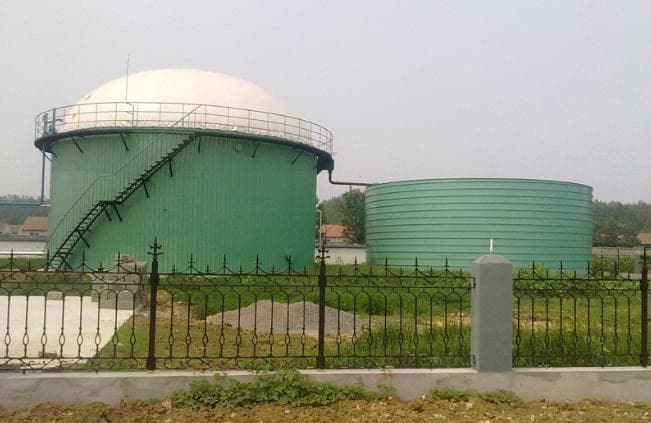
Locations, capacities and equipment types below are drawn from MOTET project records. Select a thumbnail to explore each site, or open a photograph at full size.
Click to view full image
Capacities retain the source records’ m³ notation; normalized volume and usable gas storage are not inferred. The photographs do not imply identical membranes, pressures or controls across projects.
Core Advantages
Built around stable operation, efficient installation, and lower long-term maintenance risk for industrial projects.
No separate gas-holder foundation zone is required, which makes the format suitable for retrofits and compact anaerobic layouts.
The gas path from digestion to storage is shorter, helping reduce pressure loss and condensation risk.
It allows storage, level devices, mixing interfaces, and safety components to be coordinated within one platform.
Membrane assemblies and connection nodes can be prefabricated, leaving only deployment, fixing, and commissioning for the site team.
Technical Specifications
| Typical Volume Range | 500-12,000 m3 |
| Working Pressure | 800-3,000 Pa |
| Installation | Mounted on a tank roof or rigid cover plate |
| Compatible Tanks | Anaerobic digesters, sludge digesters, and process tanks |
| Service Life | 15 years and above |
Safety Design
Level 1 Protection
Roof-mounted relief valves quickly release abnormal pressure and protect both membrane and roof structure.
Level 2 Protection
Pressure, level, and blower status are monitored together, enabling automatic interlocks under abnormal conditions.
Level 3 Protection
Hard interlocks with the flare, gas-utilization equipment, and header valves keep the system controlled during shutdowns.
Structural Design
The dual-channel design evens out internal outer-membrane pressure and improves circumferential shape control on large-diameter tank roofs.
Material Standards
Flanges and clamping details are optimized for roof-mounted connections.
Membrane seams and edge terminations balance gas-tightness with maintainability.
The membrane combination can be tuned to tank diameter and operating pressure.
Main Structure
| Roof Connection | Customized flange ring with continuous clamping profile |
| Seal Components | EPDM sealing strip with corrosion-resistant fasteners |
MOTET MATERIAL DATA
The inner membrane retains gas; the outer membrane provides weather protection and is held in shape by support air. These material options support project-specific selection, not a universal specification for every holder.
Options are references, not a performance ranking. Permeability values under different temperatures or test conditions are not directly comparable.
Inner membrane · gas retention
Source date:
Inner membrane · gas retention
Source date:
Inner membrane · gas retention
Source date:
Outer membrane · weather protection
Source date:
Compiled from membrane technical data for project-specific material selection.
These are material data, not MOTET test reports, whole-holder certification or contractual guarantees. Material permeability is not whole-holder leakage. Selection also requires gas composition, temperature, loads, interfaces and fabrication conditions; approved project and batch documents govern.
Project Inquiry
Send the capacity, site conditions, and preferred finish or structure, and we will prepare a project-specific recommendation.
Request a Quote