PRODUCTION PROCESS

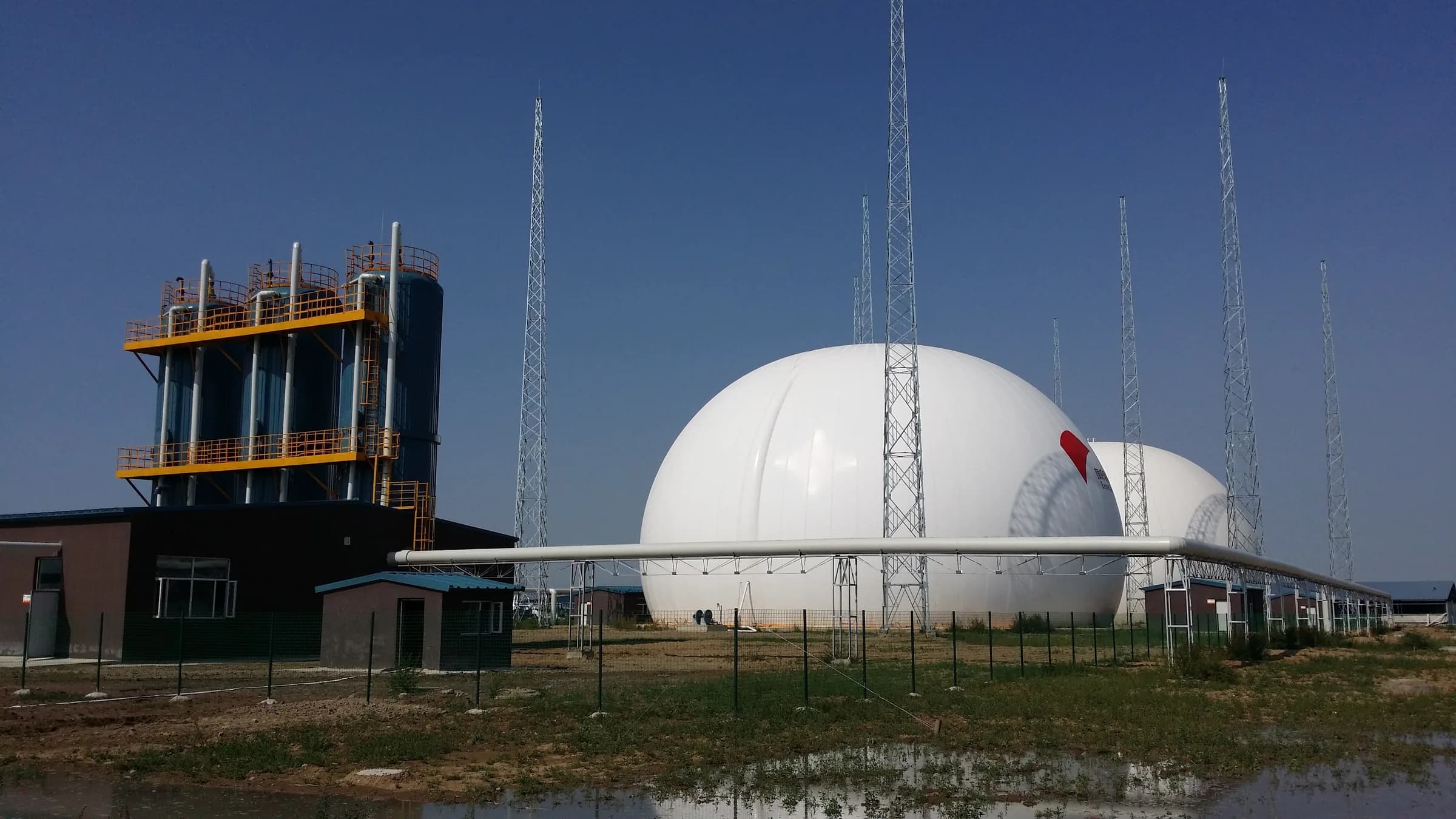
Double-Membrane Gas Holder Production Process

A full explanation of how membrane properties, labyrinth sewing, sealing welds, inflation forming, and POC acceptance fit into one manufacturing workflow.

02

Upstream property checks

06

Main production steps

04

Acceptance checkpoints

Double-membrane gas holder production process

WORKFLOW FOCUS

For a double-membrane gas holder, production is not only about joining materials in order. Upstream membrane performance directly influences cutting behavior, sewing paths, sealing quality, and the stability achieved after inflation forming. The workflow therefore starts with material-performance confirmation, moves into the main fabrication stages, and ends with acceptance and POC validation.

01 / MATERIAL FACTORS

Upstream Material Properties and Their Influence

Before cutting and sewing begin, the membrane must be understood through its load-bearing and barrier behavior. Those properties determine whether later process windows remain stable and whether the finished holder can keep long-term sealing performance.

S

Shear Resistance

Shear resistance determines whether the membrane can transfer loads stably around cut edges, corner transitions, and sewn paths. It is a prerequisite for preventing local tearing and boundary instability.

It affects edge integrity and cutting allowance, reducing stress concentration during later assembly.

It affects how the labyrinth sewing zone distributes loads and how the seam and membrane cooperate under tension.

It affects deformation control after node connection and inflation forming, shaping long-term fatigue risk.

M

Methane Permeability

Methane permeability describes the gas-barrier capability of the membrane. It is fundamental to sealing performance, pressure stability, and long-term operating efficiency.

It affects membrane selection and layer-structure confirmation, defining whether gas-tightness targets can be met.

It affects continuity after sealing weld treatment, preventing welded areas from becoming weak leakage paths.

It affects pressure retention after inflation forming and remains a key reference during acceptance and POC checks.

02 / WORKFLOW

Primary Membrane Fabrication Workflow

The main workflow follows the practical logic of double-membrane manufacturing. Each step establishes control points for dimensional consistency, sealed joints, and stable pressure behavior after forming.

01

Membrane Selection and Property Confirmation

02

Membrane Cutting

03

Labyrinth Sewing

04

Sealing Weld Treatment

05

Reinforcement Welding and Node Connection

06

Inflation Forming and Dimensional Calibration

PROCESS STEP

Membrane Selection and Property Confirmation

01

OPERATION

Confirm membrane structure, thickness, and node strategy against gas media, design pressure, size envelope, and site conditions.

CONTROL

Check shear resistance, methane permeability, layer compatibility, and downstream process fit so that material selection matches the fabrication window.

IMPACT

This stage sets the manufacturing ceiling for everything that follows, including cutting accuracy, seam stability, and sealing performance.

PROCESS STEP

Membrane Cutting

02

OPERATION

Cut the membrane according to developed dimensions, segment the material, and prepare edges for later joining and node positioning.

CONTROL

Control edge integrity, dimensional allowance, and orientation consistency so the material enters sewing without hidden edge defects.

IMPACT

Cutting accuracy directly affects alignment, stress-transfer paths, and the final geometry after forming.

PROCESS STEP

Labyrinth Sewing

03

OPERATION

Use labyrinth sewing to establish the primary joining path so that the connection zone has a clearer structural load distribution and assembly reference.

CONTROL

Control sewing path, stitch spacing, corner transitions, and local stress relief to avoid accumulated deviation before sealing weld treatment.

IMPACT

This step defines the structural order of the joined membrane area and prepares the base for sealing weld quality and global stability.

PROCESS STEP

Sealing Weld Treatment

04

OPERATION

Apply sealing weld treatment to critical joining zones and build a continuous sealed boundary with stable gas-barrier performance.

CONTROL

Control weld continuity, thermal input consistency, and full coverage to prevent under-weld, over-weld, or local shrinkage from disturbing the membrane surface.

IMPACT

Sealing weld quality determines whether the seam truly becomes a reliable sealing face, making it a decisive factor for gas tightness and service stability.

PROCESS STEP

Reinforcement Welding and Node Connection

05

OPERATION

Complete accessory interfaces, reinforcement at load-bearing nodes, and local welded connections so the membrane and its installation boundaries form one integrated system.

CONTROL

Control interface position, node alignment, and reinforcement matching so the membrane can carry loads consistently under real installation conditions.

IMPACT

Node-connection quality directly affects installation fit-up, boundary sealing, and load transfer during operation.

PROCESS STEP

Inflation Forming and Dimensional Calibration

06

OPERATION

Inflate the membrane into its target operating shape and calibrate contour, tension, and local behavior at the same time.

CONTROL

Observe formed surfaces, load uniformity, pressure response, and rebound behavior to confirm that the geometry stays aligned with design values.

IMPACT

This stage acts as an integrated manufacturing validation and can expose dimensional drift, node imbalance, or leakage risk before delivery.

03 / ACCEPTANCE & POC

Acceptance and POC Workflow

Acceptance is not a formality after fabrication. It pulls appearance, dimensions, weld integrity, gas tightness, and inflation stability back into one delivery standard. The POC stage confirms that the unit is ready for shipment or the next project milestone.

01

Appearance and Dimensional Review

Review membrane flatness, contour consistency, node positions, and key dimensions to confirm that fabrication remains aligned with developed design data.

02

Weld and Seal Integrity Check

Check sealing-weld areas, connected boundaries, and critical nodes for continuity to identify under-weld, false weld, local shrinkage, or leakage risk.

03

Inflated-State Stability Confirmation

Confirm pressure response, membrane tension, and overall shape stability in the inflated state to verify balanced behavior under simulated operating conditions.

04

POC Acceptance and Delivery Decision

Bring appearance, dimensions, sealing, and forming results together at the POC gate to determine whether the unit is ready for dispatch or the next project stage.

Production Process | 蒙特气化